

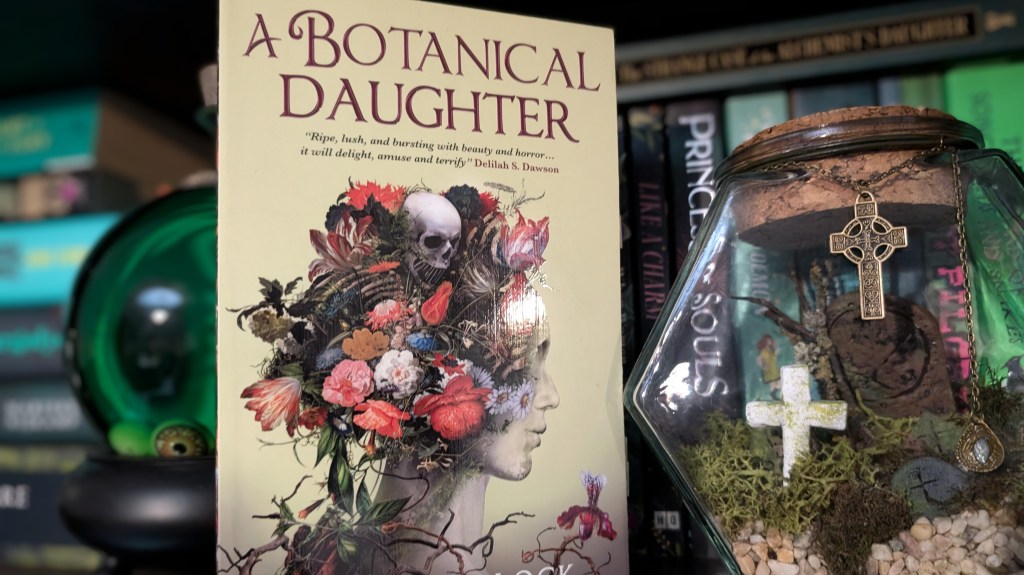
A modern Gothic novel in which two queer Victorian men conceal their relationship in a remote greenhouse, where the two create themselves a daughter from flesh and fungi. Let’s explore what makes this novel stand out among others in the genre.
I recommend reading the book prior to reading this analysis – devastating spoilers lay ahead.
Queerness in Society
Where the Gothic often implies the queerness of male characters, or turns them into ‘monstrous others’, in Modern Gothic we see queerness embraced in its naturalism. The taboo of the relationship remains through its setting within the confines of a desolate home designed to escape Victorian high society, but does nothing to dull the spark with which the two unusual men narrate their feelings to the audience.
The first, Gregor* a man of great intellect; a sullen and withdrawn academic, akin to Frankenstein in many ways, obsessed with the creation of life. Alongside him, Simon; his gentleman’s gentleman (for he is surely treated like one!) with a penchant for arranging dead creatures into interesting scenes.† The two are clear opposites yet are very much attracted to one another, not only in a romantic sense but also in a shared desire for one thing: a family, by any means necessary.
*An exceptionally Gothic name.
† Taxidermy, of course.
Typical Gothic character tropes
Of course it would not be a Gothic novel without the typical tropes, pertaining not just to the chosen landscape (a remote green-house accompanying a burned down manor), but to the character archetypes so often seen in texts of this kind.
The protagonists are so clearly ‘othered’ by the rural British populous, detached from their staff, and mistrusted yet respected by the locals, often by their own active choice (which of course is adherent to the genre). For good reason too; their hideous progeny is not only dangerous but the pair have a complex father-creator relationship with her, also similar to the tale of Frankenstein. In true Gothic fashion, their reason for isolation is an air of general ‘unease’ rather than a rational and tangible problem, despite there being one in this case… ☜
Conspiratorially, we meet Rosie, a woman of her own sordid secrecy who delights in knowing about the relationship between the two men and enjoys keeping their secrets close to her chest. She and her husband reflect ‘society’ at large; those who may judge or encourage breaking from the norm. It is through her that we learn to laugh at the moody and distant Gregor and sympathise with Simon’s plight as his sole caregiver.
We gain insight into their lives via a young, naïve and sympathetic housekeeper, Jenny; the bridge or mirror through which we may gain knowledge of the main characters’ descent into madness. Despite her slow revelations, her entrapment, and her tragic and supernatural end typical of the genre; she has her own solid reason for being there other than to serve the development of the male characters, which was (unfortunately) a refreshing change.
☜In the form of one monstrous body-and-soul engulfing botanical daughter.
A Memorable Read
What makes this an exceptional story is the parts that juxtapose the typical. This book does not fall prey to the problematic tropes of the Gothic; it uses just enough of what it needs to tell a compelling and familiar story in a modern voice.
As mentioned above, the refreshing sub-plot involving the queer romance between Jenny and the ‘monster’ was a subversion of the norm and very welcomed; after all, why have one pair of queer characters when you can have two? Not to mention, its frantic and grotesque climax was perfectly terrifying – a fantastic pay-off to the suspenseful horror of the book.
An unbearably hot and stifling greenhouse provides a setting of palpable discomfort for the reader and characters alike, with the need to keep in the heat and the secrets locked away behind covered glass panes making this just as macabre a setting as any wind-battered manor or cliff-top castle, with a refreshing twist.
In Simon, despite manipulation and lies thrust upon him throughout by his secretive counterpart, we see the voice of reason. The way he provides care for Gregor who, in turn, understands Simon and his eccentricities, shows a fulfilling gay relationship between two soft, warm and neurodivergent-coded POV characters. It is through this relationship that the two are redeemed rather than it leading to their downfall; something I believe to be vastly important to represent within literature of this kind, especially for a queer audience.
 queer crossroads
Leave a comment