


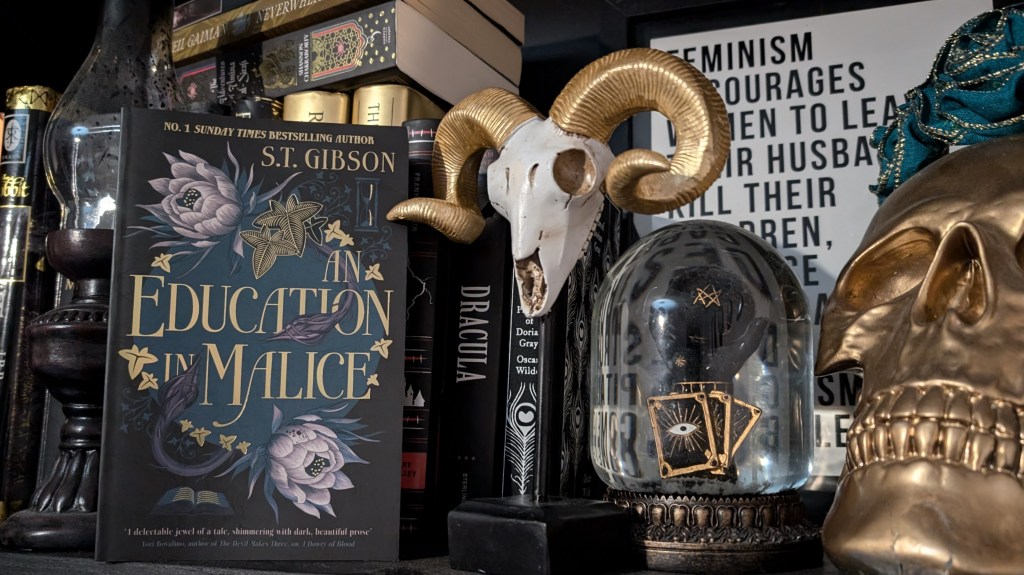
Upon reading the fiction, An Education in Malice (Gibson, 2024), I was inspired to seek out the material that helped inspire this sapphic, dark academia novel and make a comparison.
Despite hearing so many references to Carmilla (1872) in essays about queerness and the Gothic, and in works of fiction, I’d never picked up the source material and read it for myself. For context, this novel was published by a male writer in a collection of short stories, as many Gothic novellas would have been at the time. It predates Dracula (1897) and is written 25 years after Wuthering Heights. (1847)
Related post: Queer Lockwood reading in Wuthering Heights
Despite the original story being the recollection of a young woman about a female vampire who seduced her and fed from her secretly in the night, it is altogether very male centric. The narrator, Laura, talks of her seduction by her mysterious guest for a chapter or two but is then overshadowed by very vocal male characters (for example, her father, a Baron, a tradesman, a Doctor) and their opinions. The biggest tragedy of all, it seems, is not even the beheading of the vampire, Carmilla, but the silencing of Laura as her opinions become that of the male figures in positions of power over her.
So what does Gibson have to add to the story of the titular vampire and her counterpart in sapphic love? It turns out, quite a lot. In removing the male voice from the narrative and having the story be told from the perspective of the two women in the relationship, the true nature of the romance between the young women can be fully explored. Laura Sheridan, whose surname pays tribute to the author of Carmilla; Carmilla Karnstein, as she is named in the original text; and Professor Evelyn De Lafontaine, a lightly-mentioned governess in the initial novel given flesh; all build on the initial taboo of lesbian relationships alluded to in the source material. Gibson uses the names of these characters, and their descriptions and demeanour, to explore new and interesting power dynamics such as the sire-fledgling-thrall relationship, simultaneously with the professor-protégé-competitor corrupting relationships brewing within an all-girls’ college.
An Education in Malice is the right ‘next step’ for vampire fiction; paying homage to the Gothic with its poetic lyricism and setting, allowing us to explore a new level of queer taboo. Interestingly the religious sentiment of the original novel is maintained to a point, providing us with that thirst for corruption we so painfully crave from vampire novels. It gives us food-for-thought as to the moralistic choice of vampirism, not in the giving and taking of life or in queerness which at this point is commonplace and expected, but in the multi-generational abuse which can flourish in the presence of eternal life and fleeting, jealous love.
★★★★★
References
J Sheridan Lefanu (1872). Carmilla. Published in The Dark Blue Vol.2. Freund, J.C. (1873). Available online.
 queer crossroads
Leave a comment