


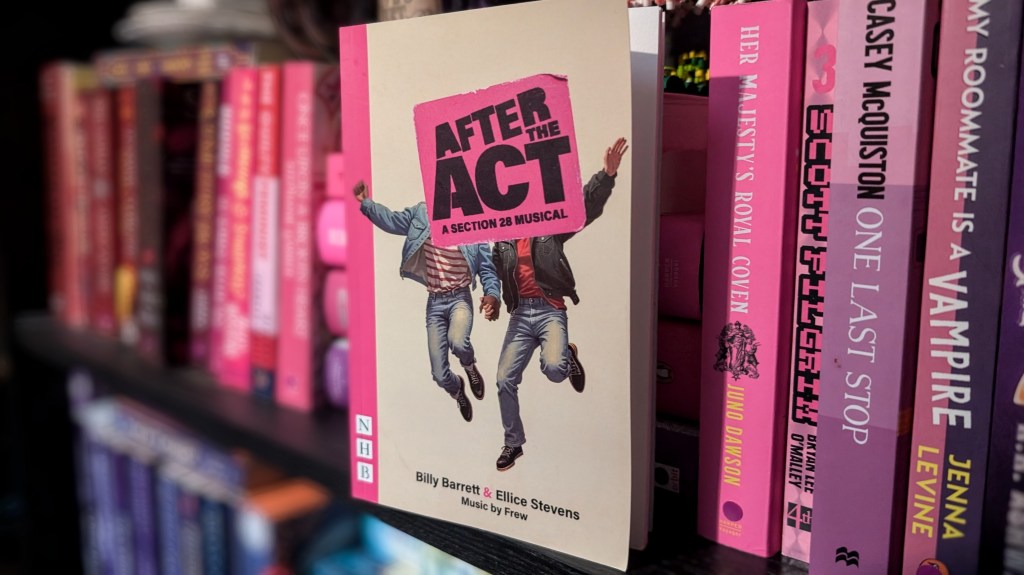
I didn’t truly understand the impact of Section 28 on queer/LGBT+ people in the UK until I saw After the Act: A Section 28 Musical – I have some thoughts…
In short, what started with unnecessary outrage about a book involving gay dads being in stock at a school in the London constituency of Haringey became a public frenzy with the eventual addition of a clause into UK law, prohibiting the teaching or reference to homosexuality in Britain’s schools.
“2A Prohibition on promoting homosexuality by teaching or by publishing material.
(1) A local authority shall not—
(a) intentionally promote homosexuality or publish material with the intention of promoting homosexuality;
(b) promote the teaching in any maintained school of the acceptability of homosexuality as a pretended family relationship
To read more about what Section 28 entailed and some key information, head here. After the Act captures headline news stories, quotes from political leaders and verbatim interviews, stirs them all together and makes an incredibly camp concoction of shocking stories about what it was like living during and in the wake of Section 28.
Section 28 Stories and Fall-Out
As 90’s kids, we weren’t around for the febrile ideological clashes or headline-grabbing protests that preceded Section 28. We grew up under its shadow – with coy half-answers from teachers and casual homophobia a part of daily life at school.
Director’s Note, After the Act, NHB Modern Plays, Pg. 8
I wasn’t around in the 80’s to witness the direct fall-out of the addition of the clause, but my generation were directly affected by it. When I first came out as bisexual in 2001, it was 13 years into the 15 year silencing of teaching about homosexual lives/existence. I was told I couldn’t be bisexual because ‘it wasn’t a real thing’; it was ‘a stepping stone to being gay’ or it was ‘a phase’. There was no education about what it meant, how it was a valid lifestyle.
And, that was it, book closed. Um, it was just terrifying if I’m honest with you. It was just like, I don’t wanna come out… I can’t be gay. I’ve just gotta find myself a boyfriend.
Character ‘LB.’ – After the Act, NHB Modern Plays, Pg. 75
I was lucky enough to find a same-sex partner when I did – we were two of about five openly LGBTQ+ people in the entire school. I had no real idea what it meant; I had no information from my school, I was bullied for being gay (which I kept to myself) and even my parents struggled to find ways to discuss this with me, waiting until I was in my mid-twenties to broach the subject. I was raised in a school playground where being ‘gay’ was a term for being ‘bad’ and because I was bisexual, I took the straighter road for, frankly too many, years after so I could just blend in with everyone else. Why push your own head in the stocks when you could just ignore that part of yourself completely?
That was the peak of ‘gay’ being used as a synonym for bad… It was just using an insult in a way to um, bring people down, I guess.
Character, Felix – After the Act, NHB Modern Plays, Pg. 75
Why After the Act is important
After the Act showcases stories from real LGBTQ+ speaking with the real voices of queer/LGBT+ people who were deeply affected by 15 years of silence. Meanwhile, it pays homage to those who fought actively to try to prevent and later revoke the clause, uses insights and musical reenactments of stories to chronologically tell the story of the rise of hatred towards gay+ people, on this year, the 20th anniversary of its repeal.
After watching After the Act I sought out some of the (publicly available) materials they used and have added them below for anyone wishing to see more of the original source material. It’s truly fascinating how little there seemed to be out there, but luckily we’ve got a surge of queer writers and historians who are up to the task.
Above: A short video interviewing an activist against Section 28 (Original reference below, re-uploaded)
I’d really recommend After the Act: A Section 28 Musical. Called ‘a Trojan horse of glittering, camp spectacle housing a documentary theatre piece that might have otherwise sounded too depressing or earnest.’ Barrett, 2024, this musical really helps to evoke emotion while also bringing forward the humour of individual characters; this helps make a very hard-hitting set of stories and the terrifying recollections of slurs and right wing rhetoric more palatable to a public audience (something that theatre does so well, but musicals do best!)
Plus, the Margaret Thatcher drag number was absolutely exceptional.
Children who need to be taught to respect traditional moral values are being taught that they have an inalienable right to be gay.
Margaret Thatcher – Speech to Conservative Party, October 1987 (15m 15s) Quoted in After the Act, NHB Modern Plays, Pg. 69
Does this sound familiar?
There is all the difference in the world between allowing adults to live in the way in which they consider right for them and trying to pervert little children…
Dame Jill Knight, Committee Stage, 8th May 1987 (quoted in After the Act, NHB Modern Plays, Pg. 47
The ways in which right wing media, politicians and parties currently use the same arguments twenty years after the repeal (35 years on from the addition of the clause to UK law), makes me absolutely sick to my stomach. If anything of this nature is added into law again we will have learned nothing from something that still affects people within living memory.
… in 2021, Section 28 was making its way back into the national conversation – less because of its impending anniversary than because… it was being resuscitated in a new form via the vicious backlash against trans rights.
Director’s Note, After the Act, NHB Modern Plays, Pg. 9
There are too many parallels between the language used around Section 28 and that around trans-inclusive education nowadays. It is my firm view that we shouldn’t just help children understand about the presence of homosexuality in schools and tolerance in general towards those different from us; we should be taught in history about the impact of these types of laws that infringe on human rights, how bigotry and right wing ideology can become law, and the fall-out from something like this so it doesn’t happen again. Let’s not let history repeat itself – won’t somebody think of the children?
References
Barrett, B. and Stevens, E. (2024). After the Act: A Section 28 Musical. Nick Hern Books.
LGBTQ+ Rights in Britain Lesson Resources – The National Archives
Pyper, D. and Tyler-Todd, J. (2024). The 20th anniversary of the repeal of section 28 of the Local Government Act 1988. [online] House of Commons Library.
Thatcher, M. (1987). Speech to Conservative Party Conference | Margaret Thatcher Foundation. [online]
Wikipedia Contributors (2019). Section 28. [online]
Lesbian protest at the BBC. (n.d.). BBC News. [online]
BREACH. (n.d.). After the Act. [online]

 queer crossroads
Leave a reply to Important Evelyn Hugo: Untold Stories of LGBTQ+ Women in Hollywood – Queer crossroads Cancel reply