

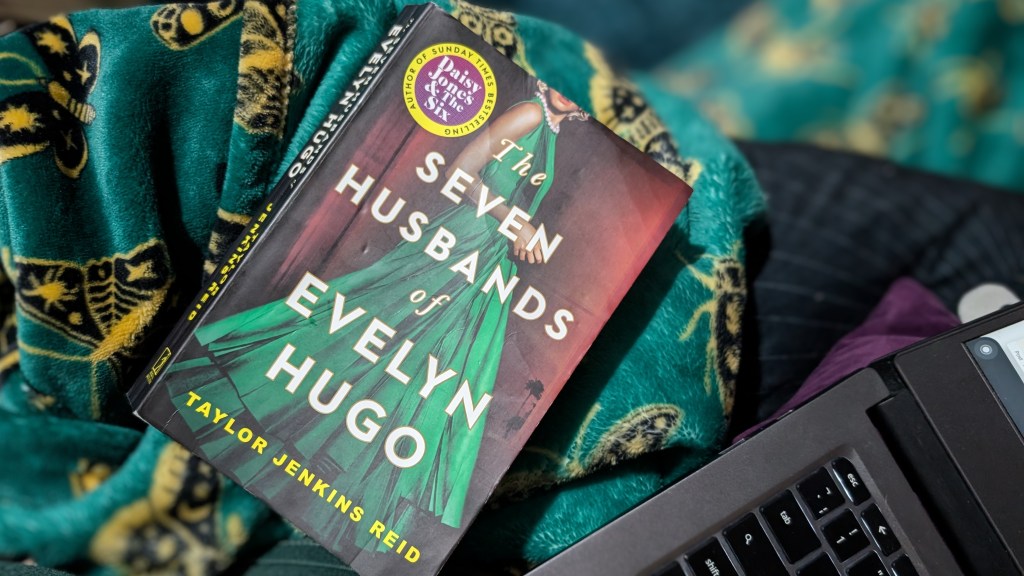
Upon reading The Seven Husbands of Evelyn Hugo I felt so compelled to write more about the themes and just how impactful this book was for me. I am so glad it’ll be a movie soon.
Note: For those who have read the book or don’t mind knowing everything about a book/movie beforehand!
Evelyn Hugo is an enigmatic, charismatic, bisexual character. Not only this but she owns every part of herself, and in death she finally wants to reveal the hidden part of herself that she’s not been able to – her sexuality in all its forms. The Seven Husbands of Evelyn Hugo is set against a backdrop of Hollywood from the 50’s to the 80’s. Evelyn gives us insight what it was like trying to ‘make it’ in Hollywood, from the white-washing of names and faces, the clear sexism that remains rife to this day, and the ruthless ways in which the media treated the lives of famous women.
“I was being designed to be two opposing things, a complicated image that was hard to dissect but easy to grab on to. I was supposed to be naive and erotic. It was as if I was too wholesome to understand the unwholesome thoughts you were having about me.”
Evelyn Hugo – The Seven Husbands of Evelyn Hugo, Pg. 51
There is something very ‘Meryl Streep in The Devil Wears Prada’ about Evelyn Hugo, and I think that’s why we love her so much. She is ruthless and calculating when she needs to be but also irrational, fearful, passionate and unapologetically herself after years of holding back her truth. Hiding lesbianism or bisexuality was not uncommon within the Hollywood spheres, and ultimately, we see that Evelyn has had quite a low self-esteem throughout her career, but in her reflections, she remains self-assured in her decisions which makes her admirable and relatable.
“I have compassion for myself. Take, for instance, when I snapped at you earlier… It wasn’t a nice thing to do, and I am not sure you deserved it. But I don’t regret it. Because I had my reasons, and I did the best I could with every though and feeling that led up to it.”
Evelyn Hugo – The Seven Husbands of Evelyn Hugo Pg.26
Something which immediately struck me one the story of Evelyn’s life started was the discussions of being a teenager who had desirable physical traits and the ways that can actually impact your self-esteem. ‘It just goes to show that if you tell a woman her only skill is to be desirable, she will believe you.’ Pg.48. Many of us are taught as children that our bodies are different from others, you can’t run as fast as your brother, you can’t jump as high as your friends… And then we’re immediately sexualised by our peers in our teens. I remember being an introverted and shy child, thrust into the spotlight when I became desired by members of the same and opposite sex for my physical attributes. These over-sexualised parts of myself were then things I attached my self-worth to, things which defined me – being desired or not desired impacted my self-esteem heavily. Evelyn teaches us all about this feeling; how she uses her sexuality for gain but how it hurt her to do so; ‘He’d convinced himself that his wanting me was my fault. And I believed him… I thought… Here is my value. Here is my power.’ Pg.43.
The Seven Husbands of Evelyn Hugo is chock full of empowering messages for women provided via an older and wiser Evelyn. It is through Evelyn that the narrator, Monique Grant, is empowered to change her life in myriad ways, including being encouraged to ‘Make them pay you what they would pay a white man.‘ Pg.27. and as we read, we feel some of Evelyn’s wisdom granted to us too. Through quotes such as ‘When you’re given an opportunity to change your life, be ready to do whatever it takes to make it happen.‘ Pg.35, and [sarcasm] ‘That is the fastest way to ruin a woman’s reputation, after all – to imply that she has not adequately threaded the needle that is being sexually satisfying without ever appearing to desire sexual satisfaction’ Pg.119 we learn more about Evelyn and subsequently ourselves.
The book’s commentary on the types of love one might experience within or without a marriage, and the reasons to stay or leave a marriage, are vast and multitudinous. We see romantic love, desire mixed with hatred, fleeting passionate love, loving a person vs loving the idea of a person, soulmates of the same sex, friends who are soulmates. Through Monique, we also experience the feelings that emerge when filing for a divorce, and the difference between the feeling of having lost love and simply feeling like you have somehow ‘failed’ at a relationship – a lesson we could all do with learning so we don’t stay in failed relationships for the wrong reasons.
Although Evelyn’s story isn’t really about her seven husbands, they serve as milestones within her life. One excellent touch I enjoyed was the prefacing of their sections with mostly one-word descriptions; Poor Ernie Diaz; Goddamn Don Adler; Gullible Mick Riva; Clever Rex North; Brilliant Kind-hearted Tortured Harry Cameron; Disappointing Max Girard and Agreeable Robert Jamieson. This reinforces to us that they are not the important ones here; they’re narrative tools by which we learn about Evelyn, which is reflective of the ways in which Evelyn often used them as tools to move forward in her life (save for Harry who gets three adjectives). S already in love with a woman while with her second husband, so it makes it all the more intriguing to find out why there were six more that followed…
This book also grapples with devastating themes of identity such as loss of heritage and white-washing, drug and alcohol abuse, diet culture, abortion, beauty and age, jealousy and domestic violence; it’s safe to say that Evelyn Hugo has been through a lot. All of these themes tie in to what we know to be true behind the curtain of female Hollywood stars of the time. All this is before we even find out that Evelyn is also a bisexual woman. The passage of time in the book is highlighted by key moments in LGBTQ+ history, such as Stonewall and the AIDS crisis, grounding this romance in reality. A reality which is ever-present in our minds as queer people, and hopefully will provide insight for others wishing to learn more.
Related post: After the Act: A Section 28 Musical Review
‘I even heard rumors the four of us were swingers, which wasn’t that crazy for that period of time. It really makes you think, doesn’t it? That people were so eager to believe we were swapping spouses but would have been scandalized to know that we were monogamous and queer?’
Evelyn Hugo – The Seven Husbands of Evelyn Hugo Pg. 234
Despite how quickly ‘things moved on’ and ‘the world is a different place’, having to hold back your sexuality still deeply affected many people who are still alive today, some who never got to live their truest selves and are now in the latter years of their life and filled with memories of lost loves that were no fault of their own. In The Seven Husbands of Evelyn Hugo, Taylor Jenkins Reid draws on this feeling and creates a story full of warmth, compassion, sadness, laughter, drama and suspense.
‘”It’s not wrong,” Celia said. “It shouldn’t be wrong, to love you. How can it be wrong?”
“It’s not wrong, sweetheart. It’s not,” I said. “They’re wrong.”‘
Celia and Evelyn – The Seven Husbands of Evelyn Hugo Pg. 172
The moment that Evelyn becomes a wife to her decade-long lover Celia St. James is a poignant and beautiful one. After witnessing the struggles and hoops the pair jumped through to keep their love a secret for so long, in a world that did not understand them, meant that this moment came with a cathartic and bittersweet release. This book calls into question everything we know about the act of marriage and it all culminates in this beautiful moment where the marriage that Evelyn wanted all along happens for her and ironically, the truest part of her is the part the ‘history’ books would not see nor record. This book contains so much heart and is deeply moving and thought-provoking that I can’t help but wish for it to do well in movie form to make it accessible to an even larger audience.
 queer crossroads
Leave a comment