

Red wine, scarlet roses, crimson lipstick, blood stains. There’s so much that connects the colour red with the danger, passion and seduction of the vampire.
The colour red is found in nature: in flowers, fruit, gemstones, fire, and blood. It is symbolically associated with a multitude of meanings, from lust and love to power, danger, and death.
The Underpinnings Museum (2023)
The Underpinnings Museum online collection Incendiary: A History of Red Lingerie, and the lecture of the same name hosted by The Feminist Lecture Program discusses the meanings we associate with the colour red. It presents examples of red lingerie throughout time, providing historical context to the artefacts displayed in the museum gallery. Corsets are some of the most prominent and well-preserved undergarments throughout this time period, and through corsetry we observe how fashion moved forward along with societal expectations and trends.
The cotton and muslin fabrics of the 1830s were near transparent and neo-classical in taste, mirroring Grecian statues and the ideas of purity and virtue. We later see in texts such as The Red Petticoat Comic Ballad (1858) where Queen Victoria allegedly wore a red petticoat to the scandal of modern society, that discourse continued to push back on anything red, with the 1870s eventually only giving way to accepting red thread on white fabric. White corsets were not merely practical but also were symbolic of a woman’s purity, with magazines often warning women against the indecent dyeing of corsets, which shifted towards the end of the century. (Lee, 2024).
“The most virtuous of us are now allowed to possess pretty undergarments, without being looked upon as suspicious characters.”
The Lady’s Realm Magazine, 1900, as quoted in Lee, 2024
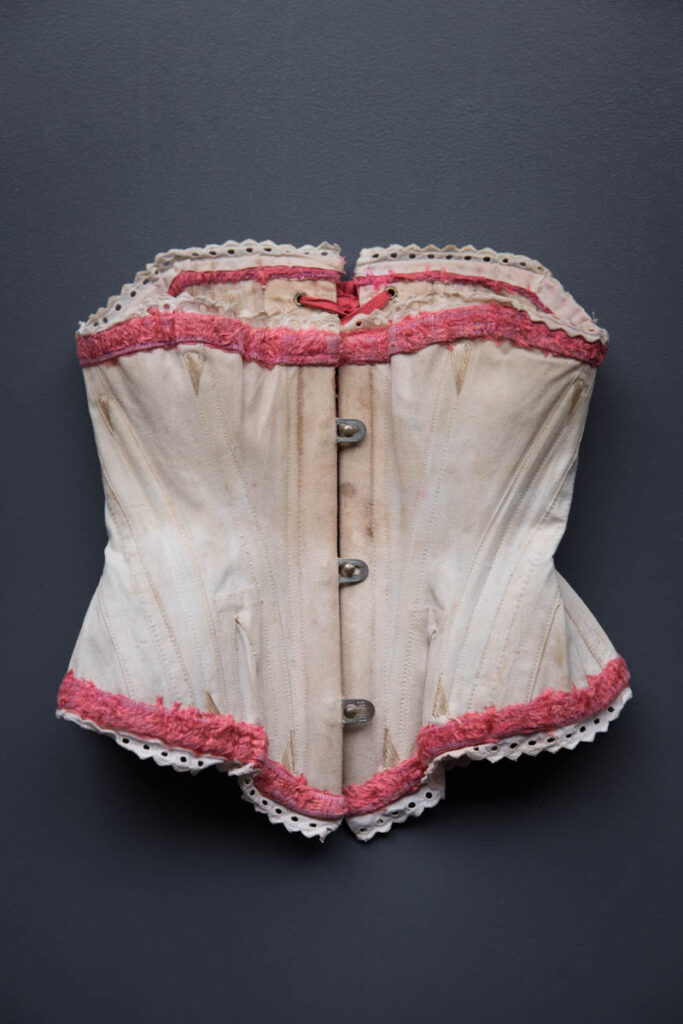
From the collection of Karolina Laskowska
© Tigz Rice Ltd 2019
Corruption and Monstrous Intent
As an enthusiastic analyst of vampire fiction, I noticed the connection between the ways society in the 1800s-1900s viewed the addition of red to white lingerie and nightwear, and the symbol of red on white harnessed in vampire novels. The flowering of blood on an ivory nightdress, the pooling of crimson on a white gown, or freshly bloodied lips pressed to a delicate handkerchief. Broadly speaking, vampire fiction became popularised from the late 19th Century onwards, so I want to explore, firstly, the views of red on white in lingerie and then the examples of white garments alongside red within vampire texts. What do we see women, both victim and vampire, wearing within these novels and what does the presence of blood or redness tell us about the characters in these scenarios?
As lingerie starts to be dyed red and have red embellishments, late 1800s and early 1900s society pushes back against the ‘seductive’ and ‘salacious’ colour, and so too do we see vampire stories pushing forward this infiltration of red into white to reflect corruption of women. We start to see stories where once ‘pure’ women in white become monstrous women who have been corrupted by vampires, and are subsequently covered in another’s blood or surrounded by scarlet colour, often without the presence of the original corrupting vampires themselves. The prescient focus within these novels is the ‘corrupted’ woman rather than the ‘corrupting’ vampire, and are often juxtaposed alongside other ‘pure’ women in white or their former self.
Early examples
At the same time a light unexpectedly sprang up, and I saw Carmilla, standing, near the foot of my bed, in her white nightdress, bathed, from her chin to her feet, in one great stain of blood. I wakened with a shriek, possessed with the one idea that Carmilla was being murdered.
From ‘Carmilla’, Lefanu, 1872
The titular vampire, Carmilla, is first seen covered in blood in a dream-like state by the narrator, Laura, who does not find the act of beautiful Carmilla standing at the foot of the bed drenched in blood to be frightening in of itself, but moreso the idea that the dream was somehow premonitory of Carmilla being the victim of foul-play is what makes Laura scared. We see Carmilla very differently in hindsight, once we know her instead as a predator with monstrous intent. Where our protagonist, Laura, sees no danger, we see ‘red flags’ galore. This belief that the blood on Carmilla’s dress is her own and not the blood of her victims, shows the protagonist’s view (and perhaps that of society in 1872) of a woman’s nature as inherently pure and good, until her true deceitful nature is revealed.
Another poignant example is the character of Lucy in Dracula, who is reflected upon by all the narrators with regards to her paleness and purity. The point where we see Lucy as a vampire and therefore no longer this figure of ‘unequalled sweetness and purity’ Pg.180, throws this coupling of corruption and crimson into sharp focus, once again;
… as we looked the white figure moved forward… we recognised the features of Lucy Westenra… The sweetness was turned to adamantine, heartless cruelty, and the purity to voluptuous wantonness… we could see that the lips were crimson with fresh blood, and that the stream trickled over her chain and stained the purity of her lawn death-robe.
Dracula, Wordsworth Classics 1993 Edition, Page 175
This description of her appearance, coupled with the blood red ‘staining the purity’ of the death gown, the suspected ‘wantonness’ and this ‘crimson’ colour are deliberate and visceral. It is through this red-on-white-fabric symbol that we see the woman before the corruption and the woman since. It is also notable that within the next few pages, Stoker uses the word ‘voluptuous’ four times: once here, once to describe her ‘grace’ when she attempts to seduce her husband to join her, (Pg.176) and then twice more to describe Lucy’s mouth. (Pg.175, Pg.178)
Second only to the word ‘purity’ in its repetition during these pages, this shows a real emphasis on what the narrator (Dr Seward), perhaps Stoker himself, and likely society would find the most atrocious part of this transition – the new-found sexuality of the previously ‘pure’ and ‘innocent’ woman. Voluptuous at the time, as it does today, would have referred to shapeliness that is sensually pleasurable to behold. It is no wonder, then, that we then see Dr Seward later emphasises his shock. It is in the following quote, and in the staining of the white death-robe that a distinct image of the corrupted, monstrous woman is achieved through the labelling of the her appearance as ‘carnal and unspiritual’.
“… the pointed teeth, the bloodstained, voluptuous mouth – which it made one shudder to see – the whole carnal and unspiritual appearance, seeming like a devilish mockery of Lucy’s sweet purity.”
Dracula, Wordsworth Classics 1993 Edition, Page 178
In The Blood of the Vampire by Florence Marryat, also published in 1897, there are more subtle nods towards the ‘nature’ of the dangerous female vampire through the use of scarlet and white. Within the novel, Harriet Brandt, is said to be the daughter of a vampire and have ‘bad blood’ due to her heritage*. When Harriet is described she is dressed in a ‘white frock… wreathed with scarlet flowers‘ (Chpt VI) or ‘shading her glowing eyes under a scarlet parasol.’ (Chpt VIII). Although Harriet is not a traditional vampire, in that she does not drink blood, we still see the presence of red on white within the descriptions of what the characters perceive to be a ‘cursed’ young woman who believes very much that she is innocent. The word ‘crimson’ is used twice in the novel, specifically during times when Harriet protests her innocence, and specifically to describe her lips. (Chpt. XI.)
Modern Vampire Novels
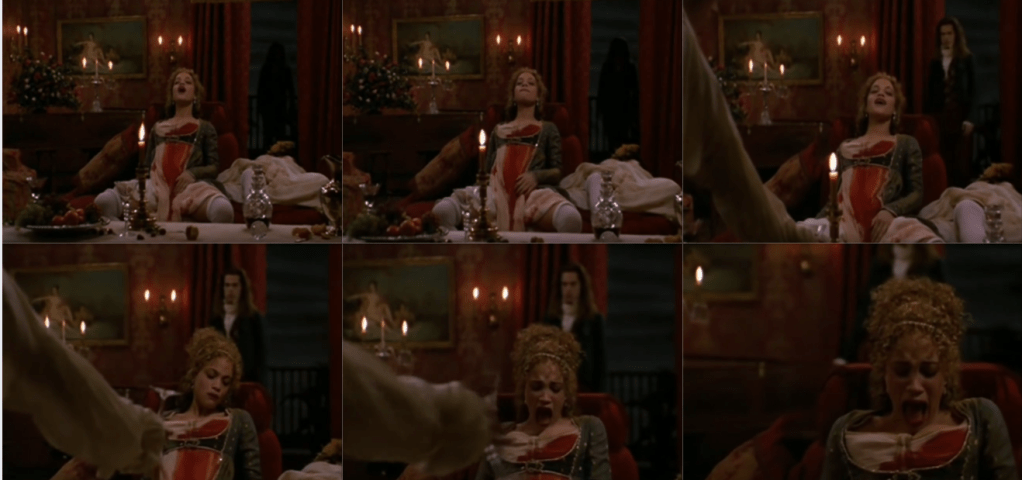
We see this ‘red-on-white’ device to indicate monstrous intent bleeding over into modern novels too. In Interview with the Vampire (1976), we see red-on-white in a boudoir scenario in a poignant and iconic scene, where a prostitute is bloodied and subsequently taunted and killed by Lestat. Below, in the 1994 movie adaptation of the same name, the blood escaping onto the woman’s white dress heightens the sense of danger and unease we feel at watching the woman captured by the dark seduction of Lestat. The allure of promised pleasure falls in sharp contrast to the heightening of fear when she realises what has happened. Here this victim writhes in ecstasy as the blood pours from her; evidence of her existing corruption before she calls for a priest. The misled individual is seduced by the idea of potential sensuality and is subsequently deceived, and her ‘sins’ are not truly forgiven before her death.
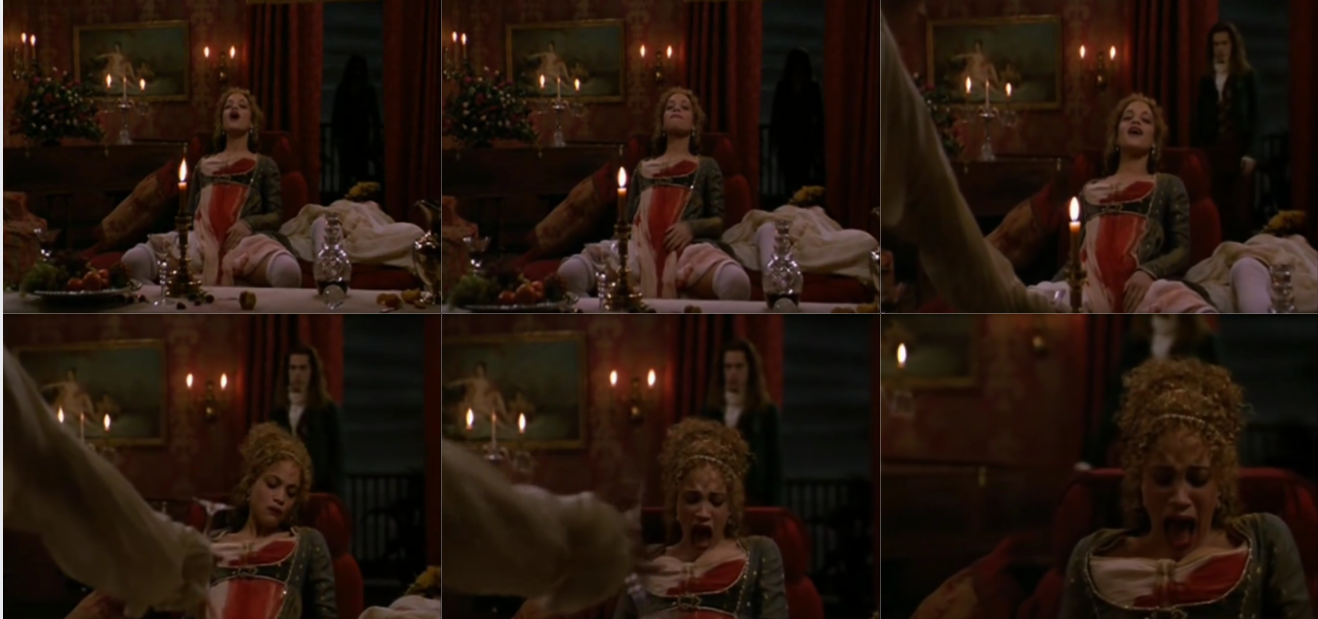
depicting the female prey of Vampire Lestat, sporting a bloodied white chemise on her newly bitten breast.
As this woman was sinful and ‘nothing but a whore’ Pg.80, she is not turned into a vampire, perhaps because she does not fit into the innocent-turned-monster role. It is only when Louis and Lestat find Claudia that the “innocent girl to newly-corrupted vampire” transition can take place. What is most interesting in this case is the suspension of her innocence, through the eyes of our narrator, Louis, and how this coincides with the delay of blood hitting Claudia’s white clothes.
Claudia is a child when she is turned into a vampire, and despite Louis knowing she is monstrous, he and Lestat continue to dress her in ‘white puffed-sleeved gowns… as if she were a magnificent doll.‘ Pg. 92. Lestat and Louis do not see past the facade of innocence when it comes to her vampiric ways, despite sixty-five years passing with her taking the lives of others, and Louis recognising she becomes ‘an eerie and powerful seductress’ and that there was now ‘something dreadfully sensual about her’ Pg. 94. It is in a crucial moment, where Claudia finally turns upon her maker, Lestat, and kills him, where Louis truly sees what she is capable of, that Claudia is finally depicted with blood on her, as it ‘stained her dress, her white shoes, her cheek’ Pg.126 It is at this point that Louis sees the corruption within her and so we see it outwardly upon her clothing and skin.
More recently, The Ashes & the Star-Cursed King by Carissa Broadbent (2024) utilises a similar device well. When protagonists Oraya and Raihn visit a distant cousin, vampire-princess Evelaena, in her desolate, remote and ancient city, we feel uneasy when we are introduced to this new character with the immediate spilling of blood, coupled with old blood stains.
She rose. Her white gown dragged along the floor as she stepped down the dais steps, the hem bloodstained and dirty. It…was an outdated style, like she’d gotten it about one hundred and fifty years ago. Maybe it had been beautiful back then.
The Ashes & the Star-Cursed King – Pg. 124. Broadbent, 2024
The ‘blood on a white gown’ image here gives us an incredible characterisation of this vampire relative. She does not follow the protocols of looking one’s best for guests. The old blood on the hem is a challenge; showing openly that she does not hide her bloodlust like other vampires do. It instantly highlights her savage nature, and the age of the blood reflects her lack of connection with vampire society at large.
Within the same page, Evelaena gracefully puts her hands onto Oraya’s shoulders in greeting and draws blood from her mortal flesh with her fingernails. As she does this she continues to greet the party as if this is a normal thing to do. The juxtaposition of this act of unprovoked violent hostility, coupled with the act of hospitality, is further emphasised by more ‘red-on-white’ imagery, when Evelaena returns to her chair, maintaining a ‘dreamy smile’ and “fold[s] her claw-tipped hands at her lap, leaving specs of bright-red blood on her dress.” Pg. 124. We are left feeling the same unease that the visitors feel when entering Evelaena’s home/lair from this use of blood on her clothes – the old blood reminding us of just how long she has been corrupted, heightening the chaotic nature we see when she maintains her smile and draws new blood.
Conclusion
The ‘corruption’ of ‘pure’ female characters often coincides with the use of red shades or stains on their white nightgowns and dresses, with particular emphasis on their new-found sensuality coupled with their monstrous presence. This may have initially mirrored the judgement society placed upon women who included red into their garments and the perceptions that the colour red presented to a 19th Century audience with regards to the aforementioned sensuality. This imagery has trickled down through the years and found its way into modern vampire stories, from the more conservative Vampire Chronicles of the 1970s to the more liberated women within vampire novels of today. It has been interesting to work this way, finding ways that my hypothesis has been displayed through works, and I look forward to the next time this happens. Thanks for reading.
References
The Underpinnings Museum. (2023). Exhibition: Incendiary: A History Of Red Lingerie | The Underpinnings Museum. [Available online] / [Accessed 16 Dec. 2024].
The Feminist Lecture Program. (2018). The Incendiary History of Red Lingerie. [online] [Accessed 18 Dec. 2024].
Facebook.com. (2016). 254K views · 10K reactions | A beautiful scene from ‘Interview with the Vampire’ | By Anne Rice | Facebook. [online] [Accessed 16 Dec. 2024].
J Sheridan Lefanu (1872). Carmilla. Published in The Dark Blue Vol.2. Freund, J.C. (1873). Available online.
Broadbent, C. (2024). The Ashes and the Star-Cursed King. Tor Bramble.
Rice, A. (2012). Interview with the vampire. London (Great-Britain): Sphere, Impr.
Bram Stoker (1993). Dracula. Ware: Wordsworth. Originally published 1897
Lib.md.us. (2025). The Blood of the Vampire, by Florence Marryat—A Project Gutenberg eBook. [online] Originally published 1897
*I am deliberately leaving out the direct and open racism involved throughout The Blood of the Vampire as this would need to be an entire other essay.
 queer crossroads
Leave a comment