

So I’ve been told A Court of Thorns and Roses is a gateway to other more monstrous ‘fated mate’ stories…
…so, settling in to re-read ACOTAR for the third time, I pondered the use of mated pairings in the fae realm and why stories involving pair-bonding with the monstrous, cold-blooded ‘male’ are becoming so popular; so much so that ACOTAR has been referenced as a gateway into darker, more monstrous ‘shadow daddies’.
According to market research, the ‘Romantasy’ genre specifically helped to drive a 41% increase¹ in the science fiction and fantasy genre value last year, and according to one study, moderate feelings of loneliness and isolation caused by online dating also stands at 41%². Coincidence? Probably. But it’s quite interesting that in this world of ‘What’s your favourite colour?’ first date nightmares, there is a rising interest in this genre where ‘destined’ pairings are prevalent. I want to consider this growth of the ‘romantasy’ genre and specifically the ‘enemies-to-lovers’ genre within recent years, and why this might be occurring. (Despite there being a rise in LGBTQ+ representation in romantasy also, I want to specifically address the ‘straight’ romance… just this once.)
The author primarily responsible for the uptick is Rebecca Yarros, with her novel Fourth Wing, which was reportedly the seventh bestselling book in the UK across all genres.³ While not being specifically a ‘monster’ dating story, Fourth Wing presents an alternative romance dynamic where the main character is helpless to resist the dark, brooding antagonist (plus their dragons are mated and therefore there’s still an element of ‘destiny intervening’ about it all). A conservative reasoning for the appeal of these types of books to society might be that we have collectively lost our moral boundaries and we no longer repress enough of our urges, or that this desire for dark, monstrous men coincides with women’s wish to be dominated by a man. (Probably not.)
Perhaps the increase in popularity for this type of fiction displays a natural cultural shift in what shocks us, and what we find appealing- where monstrosity thrives. Within the context of Gothic fiction, for example, the monstrous often represents the next ‘logical’ awakening of that which we repress (the vampire is secretly queer (see Interview with the Vampire, 1976), the woman is secretly sensual (see Dracula 1897)…). This type of visceral awakening to the ‘monstrous’ is encapsulated by the ‘shudder’, as Evan Gledhill (2025) mentions in their lecture (referenced below). The ‘shudder’ is that impactful moment when the canny becomes uncanny, and the ‘monstrous’ emerges and is made known, yet we remain captivated. Our interest is piqued and our desires are fuelled and we are waiting to fight, fly or fawn. By the nature of the Gothic ‘monster’ figure and the perceived ‘sensual threat’ we are simultaneously terrified and seduced. The satisfaction of this moment where the fear turns to something else may be what appeals to us…
…or maybe we’re always looking for a romantic love which is unobtainable. Kitty Drake (2025) summarises the argument put forward by Shon Faye in Love in Exile (2025);
‘Faye argues that, collectively, we ask too much of romantic love: we expect it to solve all of our problems and when, inevitably, it doesn’t live up to the hype, we feel excluded from the “happy kingdom” of successful partnership.’
A growing epidemic of loneliness may lead to mutual disillusionment when it comes to straight online dating. Women feel like they are being sold the false promise of love and romance, when all they can get, in reality, is the desire from men for sex. Simultaneously, men feel increasingly displaced from the ‘provider’ role they have been raised to fulfil, making them resentful of women. When we do find ourselves in a relationship, romance can often still feel quite stale long-term since the nature of desire (Eros) is defined by the lack, the yearning, for something unobtainable. Thus follows the draw of romance novels and the sigh of collective cultural resignation at how hard dating is. We can’t waste the precious little time that capitalism allows us to have without real love being a guaranteed outcome.
Enter the Beast.
Our ‘romantasy’ tells of a monstrous creature (an, often older, fae/vampire/werewolf/beast) that traps and seduces a young woman. It is through their love that he finds his humanity and she teaches him how to be a better man. Take Beauty and the Beast, 1992. While initially it reads as a morality tale about being nice to your servants, it is interesting when we consider what the woman, Belle, achieves from this arrangement. Yes, she gets to live in a castle but we have been made aware throughout that this is not what her goals are. She wants ‘adventure in the great wide somewhere’, she wants to read ALL the books, ‘and for once it might be grand… to have someone understand.’ We have established that the beast has his flaws, but it is his dedication to Bella that is appealing to her. (Originally this was a typo but I decided to leave it in because, this is also just the same in Twilight and all other romantasy involving a monster). He is a monster but he doesn’t hurt her, he protects her from other less overtly monstrous men. Those who appear less monstrous on the outside but are worse in secret. The ones who will break her heart. Take over her life. Squash her dreams. What she does need is protection from the true predator of the piece. Gaston. The unrequited attention of a man who does not understand her and, despite wanting to be her ‘provider’, just doesn’t ‘get’ her.
We can take this one step further when considering the fact that destiny has taken over and provided her with a ‘mate’ – a fated pairing, a bond that exists beyond mere physicality, emotions or even reason. It’s just ‘meant to be’. It’s inevitable. Imagine: despite initially not realising, a female protagonist (insert self here) is actually pair bonded or mated with this morally grey, monstrous ‘male’. That’s removed all the hard work – destiny has intervened. The getting-to-know-you part of the dating dynamic will not be in vain, like it is in real life, because it is all working towards the goal of true and naturally prescribed love. Congratulations. Before you ask, of course you still have the freewill to leave. You could decide to date, have sex or even accidentally fall in love outside of this arrangement and only the male in the scenario will fill the pain of the detachment. In the meantime, this ‘beast’ is also so terrifying to everyone else around that no other man would ever even think of coming near…
We can see why this might be appealing, right? According to another article from 2024, titled “Of course the girls are reading horny fairy books. It’s cheaper than travel and more fun than therapy“, a general increased accountability from men and the ability to be defined by one’s own acts is one reason for the appeal of ACOTAR and books like it.
In so much of popular culture the straight male perspective is prioritised and they just don’t get it. In this fantastical universe the men take birth control and, in a huge stretch of the imagination, the fairy world has bothered to invent it. The ACOTAR series goes to great lengths to demonstrate that the heroine is safe and comfortable, even spelling out how she isn’t being financially coerced… [Women] are absolutely getting laid, don’t get me wrong, but their relationships with men never define them. This point is so basic it is ridiculous to even have to make it but most movies still do not clear this bar.
Emily Mulligan for the Guardian, 2024
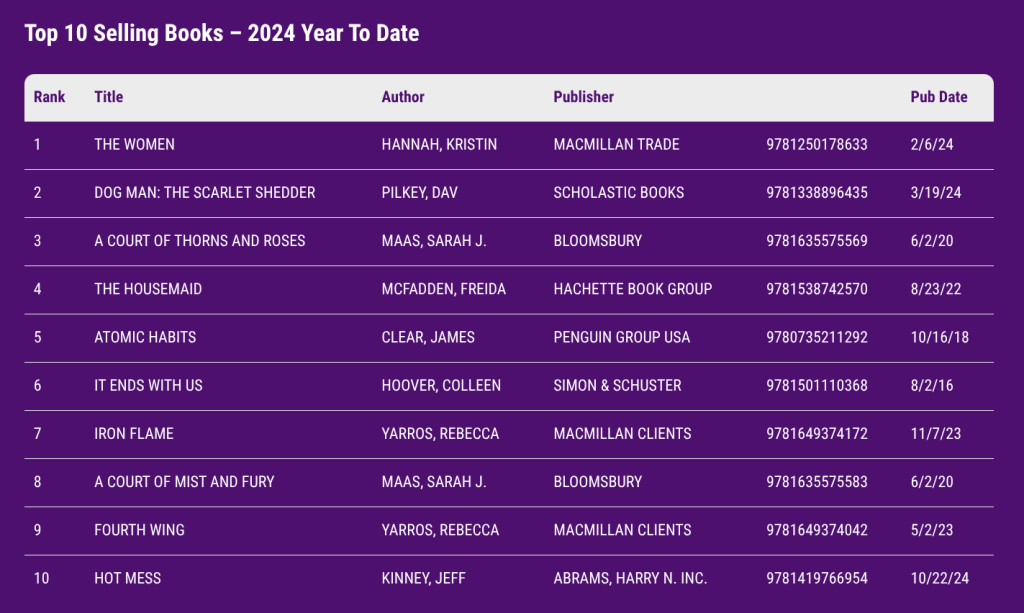
And of course, most of these fictional men are written by women. They are men specifically curated for women. So if anything, men everywhere could be picking up these books and taking some notes. Unfortunately, we do not have any more recent studies but according to the Guardian (2021) the top 10 bestselling female authors had a readership which was 81% women, with the top 10 bestselling male authors being a much more even split (55% men and 45% women).4 (Just to note, seven of the top 10 bestselling books of the year in 2024 were written by women, so it’s not like we’re not great at writing books and of the three by men, one was a children’s book and one was a self-help book.)5
So if men are not reading these books, (or statistically not reading as much in general) why is there no real equivalent fiction written by men for straight men? Well, in context of this narrative, men may well have been told they must be the ‘beast’, and desperately try not to be the ‘Gaston’, when, in actuality, what we want is a Lumiere. (Joke, but also… hear me out.) What men are sold is the idea that women want a man to fulfil these roles when what they really want is what the presence of the beast implies. Someone who just… gets her. Who she won’t be wasting her time with. Who isn’t going to think of her as a gatekeeper of her own body, but the owner of her body. This perceived ‘control’ that women have over the ‘sex resource’ could be one reason why there is no such equivalent genre for straight men. Short of the 1970/80’s ‘triple-breasted alien woman seducing me’ type of story, which remains heavily focused on sex rather than the pursuit of love, there is nothing quite like this for men. And honestly, that’s a little sad.
And that is why I wanted to end this post with an appeal to men. Read more romantasy. Women aren’t going to gate-keep this. In fact, I am sure plenty of women would love to see you read it and vibe with you about it. Not just for the notes on the sex parts, but on the ways that these books allow us to live in a world where women hold the same power you do and are fulfilled romantically in ways that perhaps you wish to be too.
References
¹ ³ Creamer, E. (2025). Romantasy and BookTok driving a huge rise in science fiction and fantasy sales. [online] the Guardian.
² Robb-Dover, K. (2024). The Toll of Online Dating: Surprising New Survey Data. [online] FHE Health.
‘I climbed into the coffin of my own freewill’: Monster-f**king and Reclaimed Agency, lecture, Evan Hayles Gledhill [online]
4 Sieghart, M.A. (2021). Why do so few men read books by women? | MA Sieghart. [online] the Guardian.
5 Circana, (no date), Top 10 Selling Books – 2024 Year to Date Accessed 23. Feb 2025, [online]
Creamer, E. (2024). A genre of swords and soulmates: the rise and rise of ‘romantasy’ novels. The Guardian. [online]
Drake, K. (2025). Love in Exile by Shon Faye review – lessons in romance. [online] the Guardian.
Mulligan, E. (2024). Of course the girls are reading horny fairy books. It’s cheaper than travel and more fun than therapy. [online] the Guardian.
 queer crossroads
Leave a comment