

Us humans; we really enjoy putting things into nice little boxes…
Gothic fiction, and in this case, vampire fiction, has always challenged our societal boundaries and how we categorise and understand the world. The nature of Gothic entities, like vampires, appear to exist outside of our rational understanding and scientific knowledge.¹ In the 18th and 19th Century, queerness, particularly between gay men, was seen to be an “affliction of the mind”, rather than a social identity. It defied what we could comprehend and so a scientific, medical model of homosexuality, “sexology”, was being formed.² Throughout the next two hundred and fifty years or so, straight white men would argue back and forth about why ARE the gays? They debated whether gayness was an “inborn reversal of gender traits”, something that afflicts a person like a “disease” or something that is fashionable so therefore “all the kids are doing it”. It seems some things never change…
Queerness and the History of Vampire Texts
Public discussion around gender and sexuality became prominent around the same time as Gothic fiction became popular. Many traditional vampire novels and short stories around the same time also link vampirism with lesbianism and sexual deviance³. Let’s take the example of Carmilla (1872) which described a ‘female malady’ that afflicted two adolescent women – the titular Carmilla (a vampire), and the human narrator, Laura. Spoilers: they were just good friends.
As we travel forward through the 20th Century, the very first depictions of Dracula on screen sparked debates as to whether showing him biting people and feeding on his victims was too graphic. Not due to the blood or the violence, but due to the sexual question-mark that hovered over the intimate ways he killed his victims. Movies that included vampires would progress from prudish off-screen death scenes, to fetishising vampires and their seductive natures. And, how do you change a vampire from being monstrous and dreadful to acceptable? …You make them women and you make them gay, of course. Lesbian vampires would come to dominate the B-movie era of the 1960’s and 70’s, as restrictions about what could be shown on screen were relaxed… and apparently we wouldn’t stop fetishising lesbian vampires for some time after.
As we move into 21st Century retellings of this novel, such as Millcara (Holly Black, 2013), An Education in Malice (S.T.Gibson, 2024) and European Travel for the Monstrous Gentlewoman (Theodora Goss, 2018) we see Carmilla reimagined as a queer elder. Rather than a soulless villain who preys and seduces women and is ultimately beheaded, we see a devoted companion and a queer role model who forges true intimate, queer and platonic connections. Rather than Carmilla being demonised, we see her queerness alongside her vampirism in modern stories, allowing for an exploration of the connection between the two.
The ways in which queerness is viewed by society has shifted along with the ways in which vampires are depicted – and that’s no coincidence. Gothic fiction allowed for an exploration of society’s darkest desires – in which modes of sexual and social transgressions could be discussed in a semi-respectable manner. It makes sense then, why queerness and the Gothic help to shape each other. As Haggerty puts it in his book, Queer Gothic;
“… they anticipate sexological analysis at precisely the moment when these questions had begun to be explored, they could serve as chapters in the history of sexuality.” – Haggerty, G.E. (2006)⁴
Although depictions of vampires in popular culture have changed somewhat from the traditional Draculian imagery, there are still some themes that remain. In modern media, vampires continue to be depicted as privileged (and for the most part, white), owning property, inheriting money, business owners or with a strong family name.
The core difference nowadays is that vampires are no longer perceived as monsters or morality tales by the audience, but more sympathetically, as something to aspire to. Their existence almost feels obtainable and yet separated from our own. We see vampires linked with themes of homo-eroticism and sexual power almost consistently in 20th Century Gothic media, but we don’t see much positive vampire queer representation until the 21st Century.
Wouldst thou like to live deliciously?
From my experience in queer spaces, we often wish we could see ourselves untamed, abiding by our own moral codes, and accepted by a small group of people who we trust implicitly. We crave the freedom of the vampire, and the protection of the coven. We seek to subvert the norm – without fear of consequence.
With the corporeal and societal boundaries we face as queer people, the kinship we feel with vampires is all about release. Release from expectations that may weigh us down as individuals of minority groups, and the freedom to explore those impulses which polite society would have us repress. Vampires are allowed to explore their sexuality and gender fully – they can be poly-amorous, promiscuous and quite often explore sex with those of the same gender.
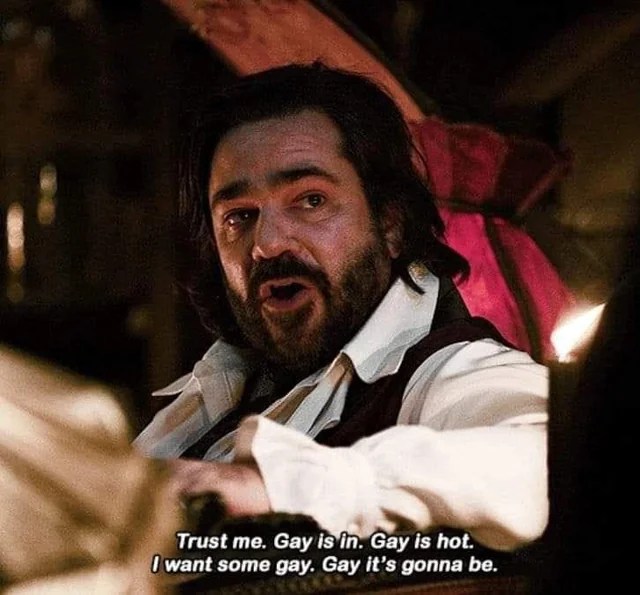
The most modern (and probably best) vampire TV show that I’ve seen, What we do in the Shadows has a particularly fluid approach to sexuality. Released in 2019, it focuses on the characters of vampires, Nadja, Lazlo and Nandor and includes many of their sexual exploits. Their sexualities are not labelled, nor inhibited in any way. Their main priority is passing as mortal, more-so than passing as straight. They also live with their human familiar, Guillermo who also happens to be gay. They are also an example of a ‘found family’ model- but more on that later.
In older novels, such as The Vampire Chronicles of the 1970’s and 80’s, vampire stories tread through their queer romantic connections and themes very carefully, always making sure to have the fire of homoerotic passion quenched before reaching any sort of climax that might validate the sinful behaviours of the vampires. Homosexuality was explored but never validated as a justifiable way of life.
Related post: Homophobia in Interview with the Vampire
Vampire lifestyle epitomises the ultimate freedom of expression and being. Vampires are portrayed as creatures of grotesque and sinful consumption, but they live wholly without fear and in pure excess. Even the vampire’s thirst for blood is a metaphor for sinful desire itself. The violent, but often erotic, consumption of blood, mirrors societies’ perceptions of queer desires; those they consume are either willing idiots or ‘tricked’ and ‘hypnotised’.
Twilight (2005) is a perfect example of a conservative leaning of vampire desire – with the protagonist, Edward, and his family, abstaining from the temptation for human blood. These vampires are made more ‘palatable’ by being portrayed as sympathetic souls who keep themselves to themselves and “only eat what they’re supposed to”. Twilight and other such stories, like Blade (1998) and The Vampire Diaries (2009), show us that refraining from consuming human blood can actually make vampires mentally and physically weaker. Almost like, repressing your most authentic self can be damaging to you… Just some food for thought.
Edward also refuses to turn, or have sex with Bella until they’re both married… yawn. But this brings us nicely onto our next section…
Religion, piety and queerness in vampirism
I think it’s a safe assumption for me to make that organised religion tends to be the enemy of queerness, and so too do we see the cross or crucifix as the weapon and the pure and the pious being the righteous opposite to the illicit act of vampirism. Christian imagery within Western vampire fiction has been given much less power over the vampire. A beautiful example of this is during Fright Night (2011) from Jerry, our not-so-friendly neighbourhood vampire, where he feigns fear of a cross saying ‘Not the cross, Charlie!’ only to then grab it and have it turn to ash in his hand. Often religious relics that we thought would destroy the vampires end up breaking, or don’t have the intended effect. What’s more… vampires perpetuate these lies so that unsuspecting victims will believe their silly little defences will work. The fools!

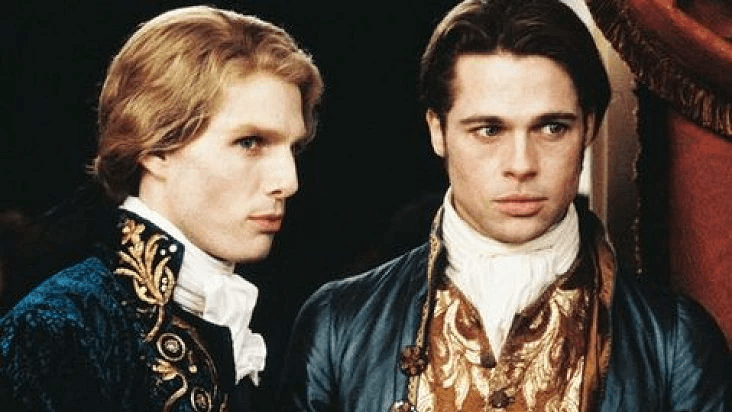
The Vampire Chronicles novels (1976) were written during the sexual liberation of the 1960’s and 1970’s as Ann herself reflected on her loss of faith. Lestat (one of the protagonists) within these books, battles with his own thoughts on religion and alternative lifestyles as he progresses through the story. Organised religion, its weapons and its followers hold no power over Lestat’s desires. Queer people have notoriously not been accepted by organised religions, and his disillusion with religion and search for a new reason to exist, could be relatable for many of us raised into a religion which does not accept our truest selves. Lestat lost the Catholic, aristocratic lifestyle which he had to become accustomed to, once he became an immortal ‘monster’. Lestat’s story also culminates in the final admission of homoerotic love as what is initially portrayed as a violent act of vampiric penetration turns into a declaration of love.
“I lifted him and carried him up the beach and back into the room. I kissed the tiny wounds, licking them and sucking them with my lips, and then letting my teeth go in again. A spasm passed through him, a little cry escaped his lips.
“I love you”, he whispered.
“Yes, and I love you”, I answered, words smothered against the flesh, as the blood spurted hot and irresistible once again.” – Rice, A. (1985) The Vampire Lestat.
Throughout her final novel in the series, Memnoch the Devil (1995), she returns once more to the importance of “Love of Men and Women for one another, and their Children”. Rice first challenges homophobic responses but then re-inscribes them later on, due to her own conservative uneasiness. In response, Haggerty says in his book, Queer Gothic; ‘it emerges… as if to mock those who imagined Rice might actually give credence to alternative sexualities’.
Ultimately, Lestat is rejected and scorned by organised religion, but starts to explore his own version of faith, embracing other parts of his seditious identity and finding out what he can do in this world with his immortality. In juxtaposition, his new companion and progeny, Louis, is pious and self-loathing; constantly at war with his basic desires, which he tries and fails to push down and ignore.
We see similarities between these vampires and the Salvatore brothers of The Vampire Diaries. Stefan being persistently guilty, weighed down by the residual humanity and wish to be ‘normal’, and his brother, Damon, seemingly being more liberated as he expresses and embraces his true desires… but still always battling with his internalised hatred for himself and who he is. Again, this all seems remarkably similar to experiences of being a queer person. We see in Damon and Stefan, and Lestat and Louis, these two ‘ways of being’ for those who don’t fit into society at large. The self-editing individual who attempts to bury desires and divergences; and the ‘out and proud’, self-assured, confident individual, who is secretly still plagued with internalised hatred for those parts of themselves that diverge from the ‘accepted norms.’
If only there was a way to build a community of like-minded people, to help support us through these challenges…
Found Family in a Vampire Coven
Vampires often live on the peripheries of society. Hidden or hiding from the community at large, unable to cross the barrier between what is viewed as natural and unnatural. They have their own ways of communicating with each other, and their own motives governed by this ‘otherness’ which they feel almost consistently. The survival of the vampire individual may rely just as much on communicating with other vampires as it does on blood consumption⁵, as the isolated vampire is continuously at risk of exposure to the dangers of being misunderstood by wider society.
All this may seem very familiar to you if you are a queer person. We find ways to connect with our own and help one another. We create our own communities with others who understand our experiences. This often results in a close knit support network or, if you’re lucky, a “found family”. The aforementioned What we do in the Shadows, we identified as a vampiric found family, and we also see this in the Cullen family from Twilight, and the tight-knit friend group in The Vampire Diaries when the protagonist, Elena loses most of her blood relatives. Many vampires are cast out from their families, only to find a much better and more supportive family elsewhere, who accept them for who they are – blood sucking and all.
The Interview with the Vampire, sees Louis and Lestat explore their desires, cohabit, raise a child together and have a deep affection for one another, despite their differences. Although not explicitly a gay relationship, it does allow for an open expression of love between two men in a setting that is neither hetero-normative or traditional. How avant garde! The importance of community is clear to vampires who wish to survive, particularly for those who are minorities even within the vampire world, such as those who choose to drink animal blood to spare killing humans. What’s interesting is this also parallels the negative aspects of queer community too. In vampire media there is a great emphasis placed on the wisdom of elder vampires vs “new-born” vampires who don’t know what to do with themselves and how to handle their new identities.
The French coven in The Interview with the Vampire, the Volturi in Twilight, the Vampire council in What we do in the Shadows… these larger, older communities are depicted as “knowing better” and keeping track of the smaller pockets of communities that are forming. It’s a hierarchical system that often ends up in bloodshed or at the very least some form of power struggle. We unfortunately see this so much in the “elder queer” gatekeepers who tell others that their experience of queerness is not valid or ‘enough’.
Of course, I am not talking about those individuals who paved the way so others might exist more comfortably, but those who feel that the marginalisation of their generation is something that is not shared with the ‘baby’ trans and the ‘passing’ bisexuals in heterosexual relationships. The idea that the older generation knows better, and can’t adapt to changes within their own smaller communities is unfortunately so similar to what we see today, where people who are new to the community are not seen as worthy of the same respect as those who have existed within it for a long time.
Most modern, sympathetic depictions of the vampire show them as people who wish to co-exist with others peacefully, while embracing and being understood for their differences and living privately. Through these different depictions of vampires, we can understand their almost human desire for acceptance. We also learn that those closest to us are not always the ones who can keep our secrets, or those that we can rely on the most.
Vampires and the Ideal Self
The vampire body is one released from its earthly shackles and given eternal beauty, youth and peak physical fitness, often at the cost of the soul or becoming a “monster”. Of course, when I first encountered vampire media during my teenage years, I thought, wouldn’t it just be great to not have to worry about getting sick? Or being able to physically achieve something astounding? Or do whatever you want whenever you want? It’s no coincidence that we, as queer teenagers, or teenagers in general, are attracted to the idea of vampires.
“… vampires can serve to represent many of the problems that young adults find themselves working through… vampires represent everything that most teenagers are not, but might like to be – fearless, attractive, powerful, cool, independent, unsupervised and intelligent.” – Overstreet, D.W. (2006)
One particular novel that uses this trope really well, is Holly Black’s The Coldest Girl in Coldtown (2013), where vampirism is common knowledge to humans and a commodity, fetishised and is ultimately an allegory for capitalism as a whole. Teenage fans are known to run off to join the vampire-run town, despite the warnings, because they idolise these creatures of incredible power and charisma.
One notable queer-representation is the trans character, Valentina, who is essential to the story and her being trans is a clear reason for her motivations [minor spoilers]; as the character thinks that her being trans will affect whether her love interest will want to be with her, but actually it’s the fact she wants to be a vampire that worries her love interest, nothing to do with her transitioning at all.
The reason that teenagers (and older fans, I am sure) want to be vampires is the thought of becoming their most ideal selves while maintaining their youthful forms. Not only are vampires physically superior to humans, their minds are also sharper and more astute, their senses heightened and they perceive the world around them with more focus, to truly see the beauty in it. They are enhanced and perfect versions of themselves. I can see why this might appeal to many of us, in particular our trans siblings, who are often made to jump through hoops to feel more like their authentic selves.
This is where I want to look in particular at Guillermo from What we do in the Shadows, the human familiar, body-guard and friend within the vampire family who wishes more than anything to become his truest self, and become a vampire. The reason why people, and particularly queer people, feel such kinship with Guillermo, is that we are all him. As Harvey Guillén, who plays Guillermo, puts it in an interview All Vampires are Queer for The Bald and Beautiful Podcast;
“We’ve all been in a toxic relationship. We’ve all been in a job which overlooks us for a promotion… We’ve all been Guillermo, so the reason that we follow the human familiar story… is because, bitch, we’re all him. We root for him because we root for each other.” [29:21]
Guillermo as a gay, human character within this queer vampire space is the only one not embracing himself to the fullest within the house, and he yearns for that freedom to do so. He initially hopes more than anything to become a vampire.
“Being queer is not the demise of anyone; being queer is part of their life and it’s just intertwined into the story and it’s never the topic of conversation… In this world… you happen to be queer and you’re thriving.”
By embracing our truest and most powerful selves, we are not just what the world makes of us, but we can embrace it as part of ourselves and then focus on our own stories within it. We don’t have to hide ourselves away from society and our sexuality isn’t even the most interesting thing about us. As Harvey Guillén later concludes,
“If you live for hundreds of years, what do you have to fear? The reason people are scared to come out and be queer is because their society has made them scared to come out… but if you’re a vampire what do you have to lose?” [44:53]
Embracing the inner monstrous self
So as we can see, things have moved on significantly from the days of seeing people as ‘monstrous others’… right?… right?? Queer people are not some abomination of nature, waiting for the moment they can hypnotise your children by reading them stories or devouring your wives in secret… promise. Far from the Counts and Carmillas of the past, modern vampire characters just want to be understood, acknowledged, and to coexist with a group of other vampires, having sex and living their best undead lives.
Queer people, particularly in the last 20 years, have been given more legal recognition and protection, allowing our communities to flourish and grow, trailing after the aforementioned growing sympathetic depictions of vampires of the 80s, 90s and early 00s. Gothic fiction is often the first genre to reflect and challenge issues of sexuality – so hopefully at least from a fictional media perspective, perhaps it’s showing what’s to come?
Although the current climate for queer and particularly trans people is one of turmoil, being ever-debated by society at large, let us seek hope in the representations we see of vampires. For if we’re now starting to see fantasies whereby stories about a found family of sexually liberated vampires can comfortably join mainstream media – then let’s hope that the real world can catch up.
References
- Hillard, Tom J. “Deep into that Darkness Peering.” Hosted by Edge Hill University – LINK.
- Kennedy, C.S. (2011) ‘Queer Gothic: The Fin de Siècle, Sexology, and the Aesthetics of the Other’, in Hughes, W. and Smith, A. (eds.) Queering the Gothic. Manchester: Manchester University Press, pp. 20–34
- Haefele-Thomas, A. (2012) Queer others in Victorian Gothic: Transgressing monstrosity. Cardiff: University of Wales Press.
- Haggerty, G.E. (2006) Queer Gothic. Urbana: University of Illinois Press.
- Davidel, L. (2020) ‘Liminal Creatures: Representations of Monstrosity, Queerness, and Procreation in Anne Rice’s The Vampire Chronicles’. Paper presented at IDEA Doctoriales 2020, Nancy, France, January 2020
- Overstreet, D.W. (2006) Not Your Mother’s Vampire: Vampires in Young Adult Fiction. Lanham: Scarecrow Press.
Note: I use ‘queerness’ for ease when discussing the LGBTQ+ collective at large, and I am also looking at this from a Western lens.
 queer crossroads
Leave a comment