


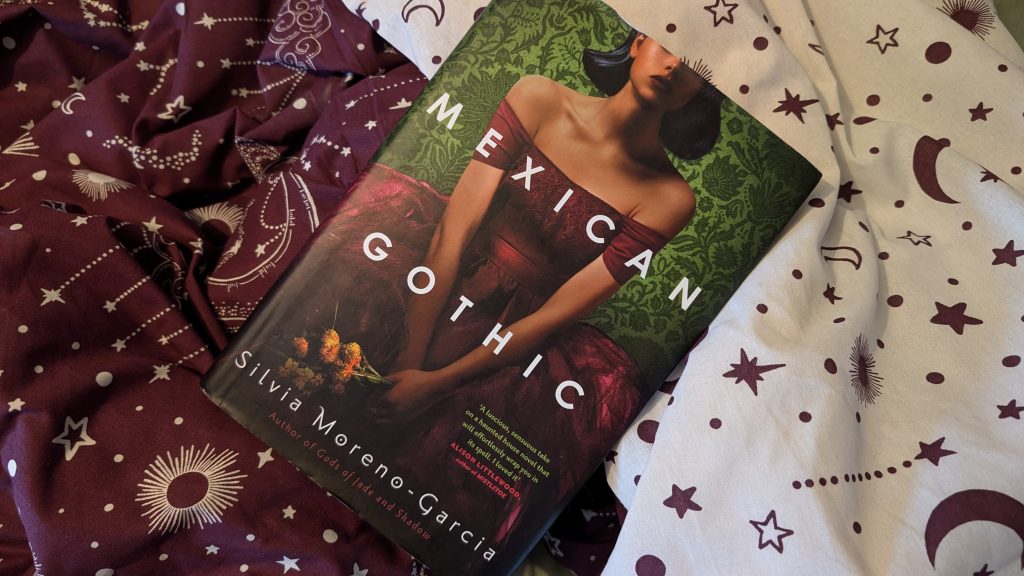
What are the key differences between a fairy-tale and a Gothic novel, and how close are they to one another, really?
Disclaimer: Minor thematic spoilers for Mexican Gothic by Silvia Moreno-Garcia
We see the concept of the Gothic story as a twisted fairy-tale throughout Mexican Gothic, by Silvia Moreno-Garcia, as the protagonist, Noemi, consistently refers to the existence of both fairy-tales and Gothic stories by name. Stories such as Cinderella, Wuthering Heights, Beauty and the Beast, Sleeping Beauty, Snow White, and Jane Eyre are referenced in myriad ways from the very beginning.
As soon as we enter High Place, where our protagonist goes to retrieve her cousin, Catalina, Noemi describes her guest bed as “like something out of a Gothic tale” Pg.23, and it is through these immediate, direct, almost ‘meta’ references to fiction that we are prepared for the Gothic story about to unfold and the knowledge that the protagonist, the book and its author were all very self-aware that there is a story here to impart. A lesson to learn. A journey to be taken.
“Have you been pretending you live on a windswept moor, like in Wuthering Heights?” Noemi asked. Catalina had worn out the pages of that book.
Noemi Taboada to her cousin, Catalina, in Mexican Gothic, Pg.49.
In using this device that seeks to reassure us that the story will follow the prescriptive path, we are made to ache for the confirmation that we will get the ending we desire; that of the traditional Gothic whereby the status quo is returned, with the audience and protagonists forever changed, but with hope of the world continuing as it did before prior to the threat.
Although what is happening to Noemi is incomparable to a traditional fairy-tale, it is through her ‘story-telling’ lens that Noemi first separates herself but then becomes immersed in what is happening around her, perhaps as an act of self-preservation. As Noemi endures the traumatic occurrences at the Doyle household, she recalls fairy-tale scenarios that her cousin, Catalina, believed she would live in. Even Virgil, Catalina’s husband and captor, understands how he could have ensnared the trust of Catalina as he says “Your cousin has a wild imagination. I think she saw in me a tragic, romantic figure.” (Pg.164.) and the staff are likened to those in Beauty and the Beast for their ability to remain ‘almost invisible’. (Pg.59)
When trying to explain how ‘normal’ the corruption within the Doyle household is, Howard makes direct comparisons to historical royal families in order to normalise the Doyle marriages between cousins. In retaliation, Noemi says “You think you’re a king, then?” (Pg.75). It is through her familiarity with stories, coupled with her vast knowledge of history, anthropology and art that Noemi survives this manipulation long enough to uncover the mysteries of High Place and stays resilient where her cousin did not.
Within the house we start to see the use of mythical creatures in the furnishings; the Ouroboros for the most part, as well as cherubs, serpents and nymph carvings in the woodwork. Nymphs (being the female personification of nature) play a role within Greek stories and it is due to the connotations of these stories that Noemi (and the reader in turn) is made uncomfortable when her male hosts are close to them and idly touch them. It is through the use of these small details and their related stories that our discomfort is heightened (so cleverly) throughout.
“Ophelia dragged by the current, glimpsed through a wall of reeds.This was Catalina that morning.”
Mexican Gothic, Pg.48
Like a traditional Gothic novel or fairy-tale, we see Catalina as a ‘damsel in distress’ or in a position of weakness, the ‘Ophelia’ metaphor reaffirming this. Noemi, at times, also feels like she takes on this role too, likening herself to a ‘maiden gazing out the tower, waiting for the knight to ride to the rescue and vanquish the dragon.” Pg.82. However, although Catalina’s role is the hero’s (Noemi’s) inspiration to continue on, it is also through Noemi’s recollections of her childhood “listening to [Catalina] spin fairy tales” (Pg.25.) that she becomes re-grounded and remembers parts of herself that could otherwise be lost to her surroundings. It is through the familial bond with Catalina, and the memory of their true selves at play, that Noemi draws her strength to move forward.
By chapter eight, any ideas Noemi has about a fairy-tale ‘deus ex machina’ coming by to solve her problems have been removed, when the doctor she hires is not able to ‘revive her cousin with a magic potion’ (Pg.86). It is here that Noemi starts to understand that ‘certain fairy tales end in blood’ and she is drawn into the uneasy feeling that there might be a more macabre ending to her story after all, reinforced by Noemi’s resolve as she realises that, despite her wish for a man (her father) to intervene, ‘she wasn’t going to back down.’ (Pg.93) Noemi reflects on how hopelessly Catalina is ensnared by her own love of the Gothic and tragic stories, even making reference to the author Mary Shelley, further grounding this Gothic tale into reality, recalling Catalina’s love for the ‘tortuous romance’ in the 1943 Mexican melodrama Maria Candelaria. (Pg.94.)
Cultural Stories and Survival
Mexican Gothic so beautifully harnesses the idea of heritage as a shield or weapon. Noemi starts to feel hopelessness when attaching her experiences too much to Eurocentric fairy tales, contemplating ‘the notion of enchantments that are never broken’ (Pg.115) as she falls victim to the belief that she might be living in one of Catalina’s fairy tales. It is through stories told by Mexican people (Marta Duval and Dr Camarillo) in the neighbouring village that Noemi finds the courage, knowledge and ability to continue forward. Noemi grounds herself in reality through her Mexican heritage, her memories of her own family, and also through her smoking implements – a habit that her host family cannot stand.
“It’s a famous story around these parts. I can tell it, but it’ll cost you a little… We’ve got to eat. Besides, it’s a good story, and no one knows it as well as I do.”
Marta Duval to Noemi Taboada in Mexican Gothic, Pg.67.
In discussing what is happening to her to people outside her immediate circle, and as if it were happening to someone else, Noemi preserves her mental state and does not succumb to the horrors as quickly as her cousin did. Ultimately, to unearth the horrors facing her cousin, Catalina, it is specifically Marta Duval’s stories and remedies, which Noemi pays for in part with her special Gauloise cigarettes, which helps to uncover the truth and fuels the successful separation of Noemi’s reality from fiction.
Catalina is ultimately redeemed and called ‘clever’ and ‘brave’ despite Noemi initially dismissing the notion that she would ‘have been the type to wear a bracelet of ojo de venado on her wrist’ Pg.65, showing how, initially, the stories of witches were not something Catalina would have put faith into, but in embracing the stories of her culture she may find the path to safety. Noemi notes that the expectations that Catalina has of her own destiny, learned through European fairy-tales, are unlikely and pities her cousin’s outlook on life.
Noemi rejects the overall positivity and ‘rose-tinted’ world that she now knows to be false and leans into the more trusted stories of her own culture. It is through this disinheritance of European culture and the ‘practically Victorian’ family, and the embracing of her own culture that we see hope form for these two young women that we, as readers, cling to when reading novels in the Gothic or fairy tale genre. The hope that there will be, through some great battle and perhaps loss, that a status-quo will return with the characters (and us) having learned something along the way. It is within the final pages that Noemi learns this and understands the importance of storytelling.
‘Catalina was the one who made stories up. Tales of black mates with jeweled riders, princesses in towers… But he needed a story and she needed to tell one, so she did until he didn’t care whether she was lying or speaking the truth.
Mexican Gothic – Page 300.
References
Moreno-Garcia, S. (2020). Mexican Gothic. New York: Del Rey.
Thanks for reading!


Leave a Reply